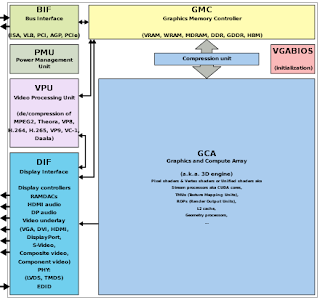
DefiNITIOn graphics processing unit (GPU) A graphics processing unit ( GPU ) is a specialized electronic circuit designed to rapidly manipulate and alter memory to accelerate the creation of images in a frame buffer intended for output to a display device. GPUs are used in embedded systems, mobile phones, personal computers, workstations, and game consoles. Modern GPUs are very efficient at manipulating computer graphics and image processing. Their highly parallel structure makes them more efficient than general-purpose central processing units (CPUs) for algorithms that process large blocks of data in parallel. In a personal computer, a GPU can be present on a video card or embedded on the motherboard. In certain CPUs, they are embedded on the CPU die. [1] In the 1970s, the term "GPU" originally stood for graphi...
Get link
Facebook
X
Pinterest
Email
Other Apps
Feature of C language
Get link
Facebook
X
Pinterest
Email
Other Apps
-
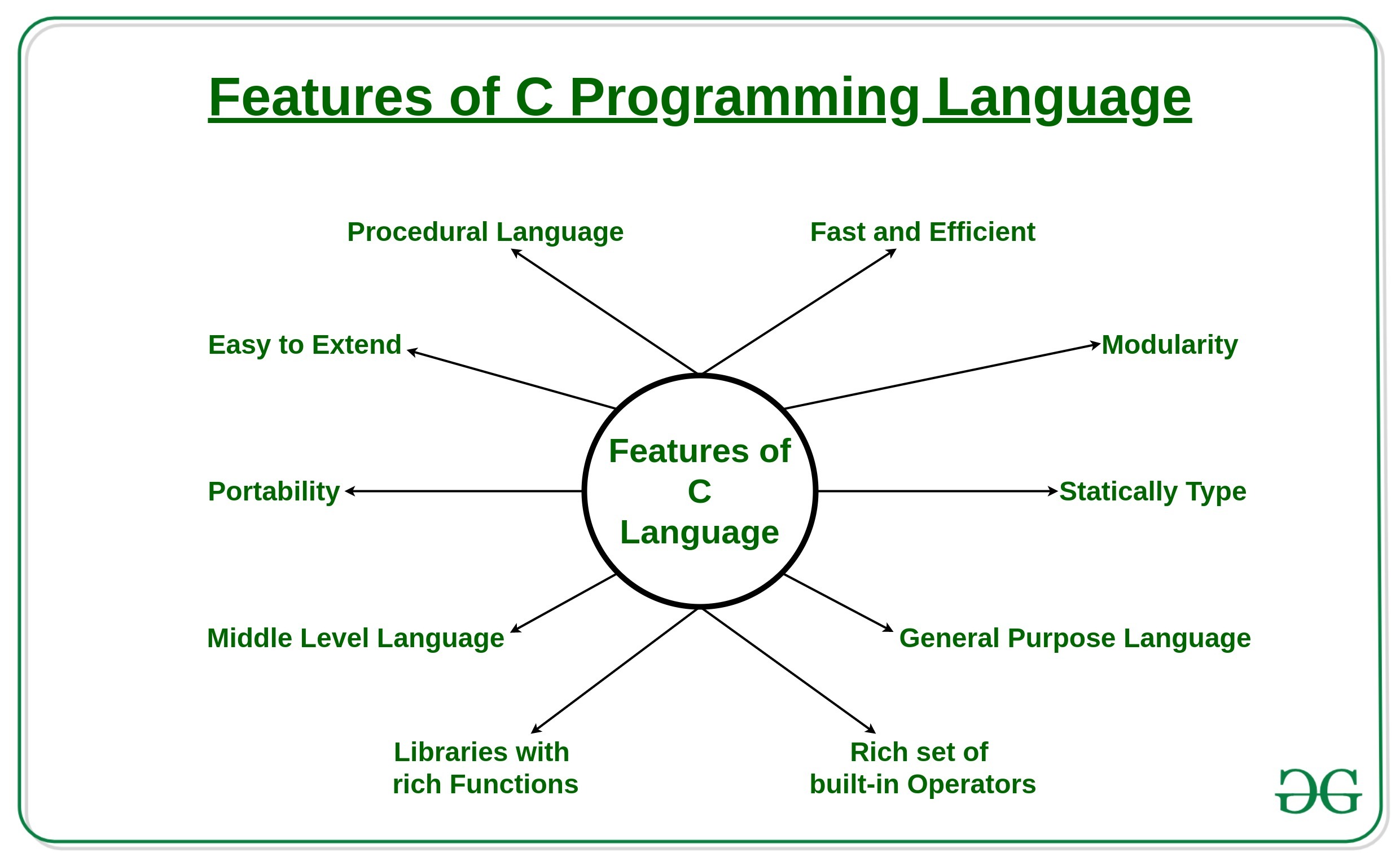
Features of C Programming Language
C is a procedural programming language. It was initially developed by Dennis Ritchie in the year 1972. It was mainly developed as a system programming language to write an operating system. The main features of C language include low-level access to memory, a simple set of keywords, and clean style, these features make C language suitable for system programmings like an operating system or compiler development.
Features of C Programming Language:
Procedural Language
Fast and Efficient
Modularity
Statically Type
General Purpose Language
Rich set of built in Operators
Libraries with rich Functions
Middle Level Language
Portability
Easy to Extend
Let us see the features one by one:
Procedural Language: In a procedural language like C step by step predefined instructions are carried out. C program may contain more than one function to perform a particular task. New people to programming will think that this is the only way of a particular programming language works. There are other programming paradigms as well in the programming world. Most of the commonly used paradigm is an object-oriented programming language.
Fast and Efficient: Newer languages like java, python offer more features than c programming language but due to additional processing in these languages, their performance rate gets down effectively. C programming language as the been middle-level language provides programmers access to direct manipulation with the computer hardware but higher-level languages do not allow this. That’s one of the reasons C language is considered as the first choice to start learning programming languages. It’s fast because statically typed languages are faster than dynamically typed languages.
Modularity: The concept of storing of C programming language code in the form of libraries for further future uses is known as modularity. This programming language van does a very little on its own most of its power is held by its libraries. C language has it’s own library to solve common problems like in this we can use a particular function by using a header file stored in its library.
Statically Type: C programming language is a statically typed language. Meaning the type of variable is checked at the time of compilation but not at run time. Means each time a programmer type a program they have to mention the type of variables used.
General Purpose Language: From system programming to photo editing software, C programming language is used in various applications. Some of the common applications where it’s used are as follows:
Databases: PostgreSQL, Oracle, MySQL, MS SQL Server etc.
Rich set of built-in Operators: It is a diversified language with a rich set of built-in operators which are used in writing complex or simplified C programs.
Libraries with rich Functions: Robust libraries and functions in C help even a beginner coder to code with ease.
Middle-Level Language: As it is a middle-level language so it has the combined form of both capabilities of assembly language and features of the high level language.
Portability: C language is lavishly portable as programs which are written in C language can run and compile on any system with either none or small changes.
Easy to Extend: Programs written in C language can be extended means when a program is already written in it then some more features and operations can be added into it.
A Internet Protocol version 6 ( IPv6 ) is the most recent version of the Internet Protocol (IP), the communications protocol that provides an identification and location system for computers on networks and routes traffic across the Internet . IPv6 was developed by the Internet Engineering Task Force (IETF) to deal with the long-anticipated problem of IPv4 address exhaustion . IPv6 is intended to replace IPv4 . [1] In December 1998, IPv6 became a Draft Standard for the IETF, [2] who subsequently ratified it as an Internet Standard on 14 July 2017. [3] [4] Internet Protocol Version 6 Communication protocol IPv6 header Purpose Internetworking protocol Developer(s) Internet Engineering Task Force Introduced December 1995 ; 25 years ago Based on IPv4 OSI layer Network layer RFC(s) RFC 2460, RFC 820 Devices on the Internet are assigned a unique IP address for identification ...
Windows Operating System History & Versions The Windows operating system (Windows OS) refers to a family of operating systems developed by Microsoft Corporation. We look at the history of Windows OS from 1985 to present day. The Windows operating system ( Windows OS ) for desktop PCs is more formally called Microsoft Windows and is actually a family of operating systems for personal computers. Windows has traditionally dominated the personal computer world, running, by some estimates, more than 75 percent of all personal computers. Beginning in the early 2000s, Windows dominance has lessened with the growth of the Linux Teacherac operating systems. Windows provides a graphical user interface (GUI), virtual memory management, multitasking, and support for many peripheral devices. In addition to Windows operating systems for personal computers, Microsoft also offers operating systems for servers and mobile devices...
DEFINITION RAM (Random Access Memory) RAM (Random Access Memory) is the hardware in a computing device where the operating system (OS), application programs. Random-access memory ( RAM ) is a form of computer memory that can be read and changed in any order, typically used to store working data and machine code. A random-access memory device allows data items to be read or written in almost the same amount of time irrespective of the physical location of data inside the memory. In contrast, with other direct-access data storage media such as hard disks, CD-RWs, DVD-RWs and the older magnetic tapes and drum memory, the time required to read and write data items varies significantly depending on their physical locations on the recording medium, due to mechanical limitations such as media rotation speeds and arm movement. Example of writable volatile random-acc...


Comments
Post a Comment