Posts

Showing posts with the label IP ( internet protocol )

graphics processing unit (GPU)
Image
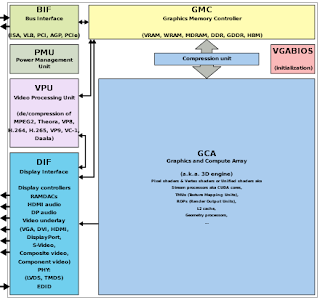
  DefiNITIOn  graphics processing unit (GPU) A  graphics processing unit  ( GPU ) is a specialized electronic circuit designed to rapidly manipulate and alter memory to accelerate the creation of images in a frame buffer intended for output to a display device. GPUs are used in embedded systems, mobile phones, personal computers, workstations, and game consoles. Modern GPUs are very efficient at manipulating computer graphics and image processing. Their highly parallel structure makes them more efficient than general-purpose central processing units (CPUs) for algorithms that process large blocks of data in parallel. In a personal computer, a GPU can be present on a video card or embedded on the motherboard. In certain CPUs, they are embedded on the CPU die. [1] In the 1970s, the term "GPU" originally stood for graphi...

IPv6 ( internet protocol version )

Image
A  Internet Protocol version 6  ( IPv6 ) is the most recent version of the  Internet Protocol  (IP), the  communications protocol  that provides an identification and location system for computers on networks and routes traffic across the  Internet . IPv6 was developed by the  Internet Engineering Task Force  (IETF) to deal with the long-anticipated problem of  IPv4 address exhaustion . IPv6 is intended to replace  IPv4 . [1]  In December 1998, IPv6 became a Draft Standard for the IETF, [2]  who subsequently ratified it as an  Internet Standard  on 14 July 2017. [3] [4] Internet Protocol Version 6 Communication protocol IPv6 header Purpose Internetworking protocol Developer(s) Internet Engineering Task Force Introduced December 1995 ; 25 years ago Based on IPv4 OSI layer Network layer RFC(s) RFC 2460, RFC 820 Devices on the Internet are assigned a unique   IP address   for identification ...

IPv4 ( internet protocol version )

Image
  Decomposition of an IPv4 address from dot-decimal notation to its binary value An IPv4 address has a size of 32 bits, which limits the address space to 4294967296 (2 32 ) addresses. Of this number, some addresses are reserved for special purposes such as private networks (~18 million addresses) and multicast addressing (~270 million addresses). IPv4 addresses are usually represented in dot-decimal notation, consisting of four decimal numbers, each ranging from 0 to 255, separated by dots, e.g.,  172.16.254.1 . Each part represents a group of 8 bits (an octet) of the address. In some cases of technical writing, [ specify ]  IPv4 addresses may be presented in various hexadecimal, octal, or binary representations. Subnetting history In the early stages of development of the Internet Protocol, the network number was always the highest order octet (most significant eight bits). Becaus...

IP address ( internet protocol )

Image
  An   Internet Protocol address   ( IP address ) is a numerical label assigned to each device connected to a   computer network   that uses the   Internet Protocol   for communication. [1] [2]   An IP address serves two main functions: host or network interface   identification   and location   addressing . Internet Protocol version 4 (IPv4) defines an IP address as a 32-bit number. [2]  However, because of the growth of the Internet and the depletion of available IPv4 addresses, a new version of IP (IPv6), using 128 bits for the IP address, was standardized in 1998. [3] [4] [5]  IPv6 deployment has been ongoing since the mid-2000s. IP addresses are written and displayed in human-readable notations, such as  172.16.254.1  in IPv4, and  2001:db8:0:1234:0:567:8:1  in IPv6. The size of the routing prefix of the address is designated in CIDR not...